


Overview
Why ITES Leaders Must Rethink Generative AI
Stop Measuring GenAI by What It Saves. Start Measuring It by What It Earns.
If your Generative AI strategy begins and ends with cost reduction, you’re already behind.
Across the ITES industry, AI has automated support desks, accelerated documentation, and streamlined operations. Those gains matter, but they’re no longer a competitive advantage. They’re the baseline.
Key points
The next wave of market leaders will use GenAI to launch new services, win larger deals, deepen customer relationships, and create entirely new revenue streams.
The question is no longer whether GenAI reduces costs. The question is whether it helps your business grow.
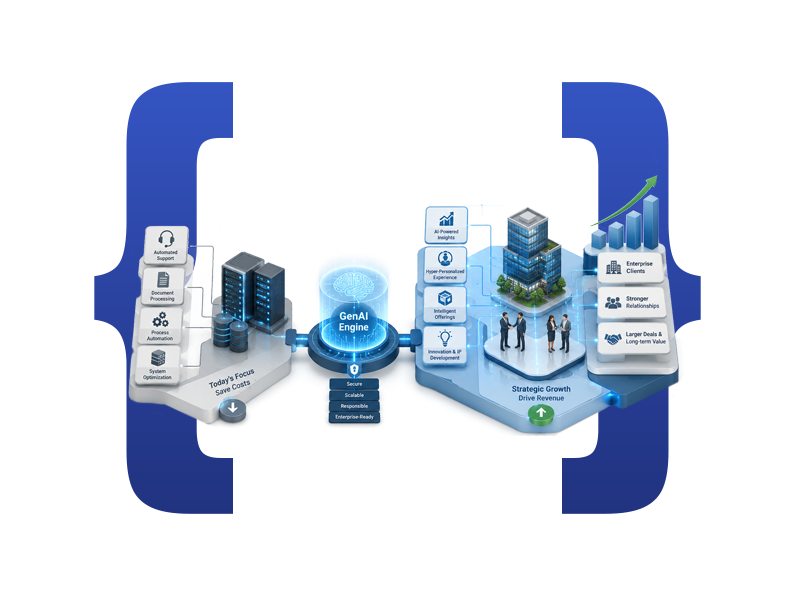
This shift marks the next evolution of digital transformation. GenAI is becoming a strategic growth engine that helps ITES companies develop new services, improve customer experiences, accelerate innovation, and unlock entirely new revenue streams.
The future belongs to enterprises that use AI not only to optimize operations but also to expand business opportunities.
This shift demands a new playbook. Instead of treating AI as an operational efficiency tool, ITES organizations must build it into their revenue strategy, service portfolio, and customer experience. Companies that make this transition first won’t simply operate more efficiently. They’ll outgrow their competitors.
From Efficiency Tool to Growth Engine
Most ITES organizations adopt GenAI in three phases.
- Phase 1: Automate
Eliminate repetitive work through AI powered support, documentation, knowledge search, and ticket management.
Goal: Reduce manual effort.
- Phase 2: Optimize
Improve service delivery, decision making, resource utilization, and turnaround times.
Goal: Increase operational performance.
- Phase 3: Monetize
Create AI powered offerings, personalize customer engagement, accelerate sales, and develop industry specific solutions clients will pay a premium for.
Goal: Generate new revenue.
Many organizations stall after automation. The real opportunity begins when AI becomes part of the business model, not just the operating model.
Why Cost Savings Aren’t Enough
Every major ITES provider can automate repetitive work. Few can turn AI into a competitive advantage.
Efficiency lowers costs. Differentiation drives growth.
Organizations that use GenAI to build premium services, strengthen customer relationships, and shorten sales cycles create value competitors can’t easily copy. Instead of competing on price, they compete on expertise, speed, and innovation.
That’s where sustainable growth comes from.
Five Ways ITES Companies Turn GenAI into Revenue
- Productize AI, Don’t Just Use It
The fastest growing ITES firms don’t stop at internal productivity. They package AI into client facing services.
Examples include:
- AI customer support platforms
- Intelligent document processing
- Enterprise knowledge assistants
- AI software testing
- Industry specific copilots
These offerings create recurring revenue while increasing account value.
- Make Every Customer Interaction Smarter
Generic experiences no longer win business.
GenAI enables organizations to deliver personalized onboarding, contextual support, tailored recommendations, and intelligent self service at enterprise scale.
The payoff is higher customer satisfaction, stronger retention, and more opportunities to expand existing accounts.
- Accelerate Revenue Generation
Sales teams lose valuable time writing proposals instead of engaging customers.
GenAI helps them produce tailored proposals, industry specific case studies, executive presentations, and solution recommendations in a fraction of the time.
Faster proposals mean more opportunities pursued, shorter sales cycles, and higher win rates.
- Scale High Value Consulting
Clients don’t pay consultants to collect information. They pay them to interpret it.
GenAI accelerates research, analyzes enterprise data, summarizes findings, and generates transformation roadmaps. Consultants spend less time compiling information and more time delivering strategic advice.
That shift increases both client value and consulting capacity.
- Build AI Around Industry Problems
Horizontal AI tools are becoming commodities. Industry expertise is not.
Healthcare providers need clinical documentation assistants. Banks need AI driven compliance and fraud support. Manufacturers need predictive maintenance intelligence. Governments need digital citizen services.
The closer AI aligns with industry challenges, the greater its business value and pricing power.
The Technology Foundation Behind Revenue Generating AI
Revenue focused AI requires more than deploying a large language model.
Successful organizations invest in a secure, scalable, and governed AI ecosystem that includes:
- Modern Cloud Infrastructure
- High Quality Enterprise Data
- Responsible AI Governance
Organizations must establish policies covering:
- Data privacy
- Model transparency
- Human oversight
- Regulatory compliance
- Security controls
Responsible AI builds trust among customers, employees, and regulators.
Common Mistakes That Limit AI ROI
Many organizations fail to realize GenAI’s full potential because they focus on technology instead of business outcomes.
Common pitfalls include:
- Treating AI as an isolated experiment
Without enterprise adoption, pilot projects rarely generate meaningful business value.
- Chasing productivity metrics alone
Lower costs are valuable, but sustainable growth requires measurable revenue impact.
- Ignoring change management
Employees need training, governance, and clear adoption strategies to maximize AI effectiveness.
- Poor data quality
Incomplete or inconsistent data significantly reduces AI accuracy and business value.
- Lack of executive sponsorship
AI initiatives require strong leadership alignment to scale successfully across the enterprise.
Measuring Success Beyond Cost Savings
Forward thinking ITES organizations evaluate GenAI using business growth metrics rather than operational metrics alone.
Key performance indicators include:
- Revenue generated through AI enabled services
- Customer acquisition growth
- Customer retention rates
- Proposal win percentage
- Time to market for new offerings
- Upsell and cross sell opportunities
- Employee productivity improvements
- Customer satisfaction scores
When AI directly contributes to top line growth, it evolves from an IT initiative into a strategic business capability.
How PruTech Helps Enterprises Unlock Revenue with GenAI
At PruTech, we help organizations move beyond isolated AI experiments to build enterprise ready Generative AI solutions that deliver measurable business outcomes. Our expertise spans AI strategy, cloud modernization, data engineering, AI governance, intelligent automation, and industry specific AI solutions, enabling organizations to scale AI securely and responsibly.
By combining deep domain knowledge with modern cloud platforms and responsible AI practices, we empower enterprises to transform Generative AI into a catalyst for innovation, customer value, and sustainable revenue growth.
Conclusion
Businesses that view GenAI as a revenue generation platform rather than just an efficiency tool will be better equipped to differentiate their services, deepen customer relationships, and unlock new growth opportunities.
The next chapter of enterprise AI belongs to organizations that combine technological excellence with strategic vision. For ITES providers, that journey starts by turning Generative AI from a cost cutter into a powerful revenue driver.