



Overview
Visual intelligence platforms are no longer a futuristic concept. They are rapidly becoming a core layer in enterprise decision making. Organizations today are surrounded by cameras, sensors, and visual data streams, yet most of this data remains underutilized. The shift is now clear: enterprises are moving from simply capturing visuals to truly understanding and acting on them in real time.
This is where visual intelligence platforms are redefining the rules.
Key points
What Are Visual Intelligence Platforms?
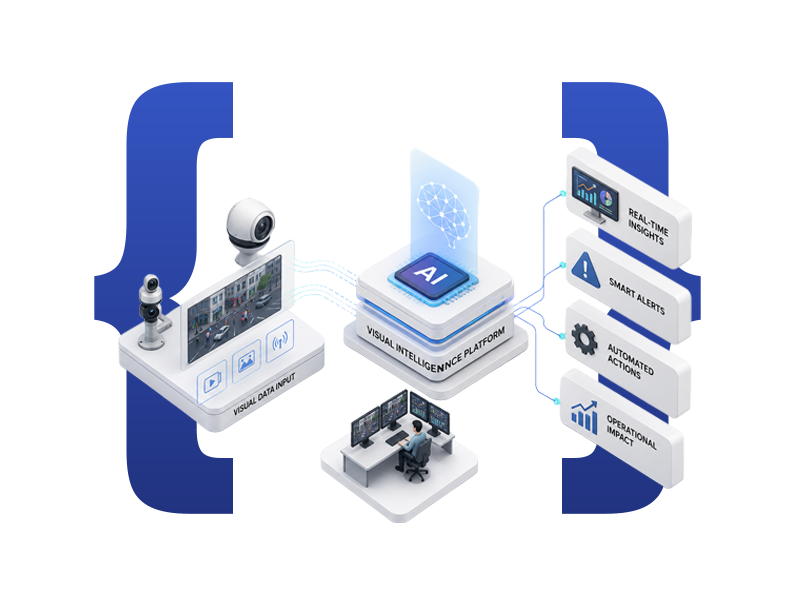
Visual intelligence platforms are AI driven systems that ingest, process, and analyze visual data such as video feeds, images, and live streams. More importantly, they convert that data into actionable insights.
These platforms do not just detect objects. They interpret context, recognize patterns, and trigger decisions automatically. From identifying safety risks to optimizing operations, they bridge the gap between observation and action.
Why Visual Intelligence Is Rising Now
The surge in adoption is driven by powerful convergence of technological advancements, data proliferation, and the growing demand for real time, intelligence led decision making. It depends on various factors that include:
- Explosion of visual data
Cameras are everywhere. From industrial facilities to urban infrastructure, the volume of visual data has grown exponentially. - Advancements in AI and computer vision
Modern deep learning models now achieve near human level perception, enabling accurate detection, classification, and prediction. - Edge and cloud scalability
Processing visual data at scale is now feasible with edge computing reducing latency and cloud platforms enabling massive storage and analytics. - Business demand for real time decisions
Enterprises can no longer afford delayed insights. Leaders need immediate visibility to act with precision.
From Passive Monitoring to Active Intelligence
Traditional video systems were reactive. They recorded events for later review. Visual intelligence platforms change that completely.
They enable:
- Real time anomaly detection
- Automated alerts and workflows
- Predictive insights based on visual trends
- Continuous operational optimization
This evolution transforms cameras from passive recorders into intelligent sensors embedded within enterprise systems.
Industry Applications
Visual intelligence platforms are not confined to one sector. Their impact spans across industries, driving measurable outcomes.
- Manufacturing
Detect defects instantly, ensure quality compliance, and enable predictive maintenance. - Retail
Analyze customer behavior, optimize store layouts, and reduce losses through intelligent monitoring. - Healthcare
Enhance patient safety, monitor critical environments, and streamline workflows using visual cues. - Transportation and logistics
Track vehicle movement, improve fleet efficiency, and enhance safety across operations. - Smart cities
Enable traffic management, public safety monitoring, and infrastructure optimization at scale.
Across each use case, the common thread is clear: faster decisions, reduced risk, and improved efficiency.
Business Value: Beyond Automation
Organizations that invest in visual intelligence platforms are not just automating tasks. They are building a foundation for intelligent operations.
Key benefits include:
- Improved situational awareness
- Reduced operational costs
- Enhanced safety and compliance
- Faster response times
- Data driven decision making
This is not incremental improvement. It is a shift toward autonomous, insight driven enterprises.
Challenges Leaders Must Address
Despite the promise, implementation requires thoughtful leadership.
- Data privacy and governance
Handling visual data responsibly is critical to maintaining trust and compliance. - Integration with existing systems
Visual intelligence must seamlessly connect with enterprise platforms such as ERP, IoT, and analytics systems. - Scalability and infrastructure
Organizations must design architectures that support high volume, real time processing. - Skill gaps
Success requires expertise in AI, data engineering, and domain specific workflows.
Leaders who address these challenges early, position their organizations for long term advantage.
The Future: Visual Intelligence as a Core Enterprise Layer
The next phase of digital transformation will not be driven by dashboards alone. It will be powered by systems that see, understand, and act.
Visual intelligence platforms will evolve toward:
- Autonomous decision making systems
- Deeper integration with IoT and enterprise ecosystems
- Context aware AI capable of complex reasoning
- Human AI collaboration for augmented intelligence
For the enterprises of tomorrow visual data will stand alongside capital and talent as a decisive strategic asset driving intelligence, speed, and competitive advantage.
A Leadership Perspective
The question is no longer whether organizations should adopt visual intelligence. The real question is how quickly they can operationalize it.
Enterprises that lead in this space will gain a decisive edge. They will move faster, operate smarter, and respond with confidence in dynamic environments.
With PruTech, organizations accelerate this journey through enterprise ready visual intelligence solutions that seamlessly integrate AI, data engineering, and domain expertise transforming vision into real time, actionable outcomes at scale.
Conclusion: From Vision to Competitive Advantage
Visual intelligence platforms turn what organizations see into what truly matters.
They unlock insights hidden in plain sight, automate critical decisions, and create a new standard for operational excellence.
Turn every frame into foresight.
Activate visual intelligence with PruTech and transform real time data into decisive action, sharper operations, and measurable impact.
Lead with vision. Act with precision. Deliver outcomes that matter.