



Overview
Smart cities are not defined by the number of sensors deployed or dashboards installed. They are defined by how effectively they converge systems, data, and decisions at scale.
Key points
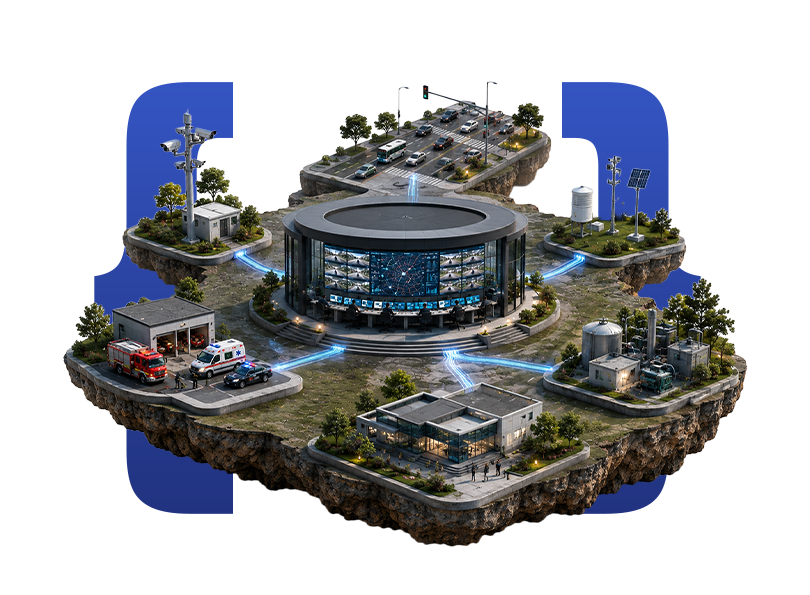
At the center of this convergence lies the Integrated Command and Control Center architecture. As urban populations expand, digital services multiply, and citizen expectations rise, ICCC platforms must evolve from static monitoring hubs into scalable, intelligent, and interoperable ecosystems.
This article explores how modern ICCC architecture scales to meet growing smart city demands while ensuring resilience, performance, and long-term sustainability.
Understanding the Role of ICCC in Smart Cities
Under initiatives such as Smart Cities Mission, ICCCs serve as the operational brain of urban governance. They integrate:
- Surveillance systems
- Traffic management
- Environmental monitoring
- Emergency response
- Public utilities
- Citizen service platforms
However, early implementations often faced a common limitation: linear architecture in an exponential growth environment.
As cities scale, the ICCC must handle:
- Higher device density
- Increased video feeds and sensor data
- Real time analytics requirements
- Multi department coordination
- Cybersecurity threats
- Demand for predictive decision support
Scaling Converge means designing ICCC platforms that evolve alongside the city.
Core Pillars of a Scalable ICCC Architecture
- Modular and Microservices Driven Design: Modern ICCCs move away from monolithic systems toward microservices based architectures. Each module such as traffic analytics, incident management, or environmental monitoring operates independently but integrates seamlessly.
Benefits include:
- Independent scalability of components
- Faster deployment of new services
- Reduced system downtime
- Easier integration of emerging technologies
This ensures that adding 500 new cameras does not require reengineering the entire system.
- Cloud Native and Hybrid Infrastructure: A scalable ICCC leverages.
- Public cloud for elasticity
- Private cloud for sensitive workloads
- Edge computing for low latency processing
Cloud native infrastructure allows:
- Elastic compute scaling during peak loads
- AI model deployment at scale
- Disaster recovery readiness
- Cost optimized resource allocation
Hybrid models ensure compliance while maintaining performance.
- Edge Intelligence for Real Time Decisions: In high density cities, transmitting all data to a central location creates bottlenecks. Edge computing enables localized processing.
For example:
- Video analytics at junction level
- Anomaly detection on site
- Smart traffic signal optimization
- Real time pollution alerts
This distributed intelligence reduces latency and network strain while improving decision speed.
- Data Lake and Unified Data Governance Framework: Scaling Converge requires moving from siloed datasets to a unified data lake architecture.
A mature ICCC includes:
- Structured and unstructured data ingestion
- Centralized data catalog
- Role based access control
- Data lineage tracking
- Compliance auditing
Strong governance ensures trust, transparency, and regulatory alignment.
- AI Driven Predictive and Prescriptive Analytics: Future ready ICCCs do not just monitor events. They anticipate them.
Examples include:
- Predictive traffic congestion modeling
- Crime hotspot forecasting
- Infrastructure failure prediction
- Flood risk simulation
AI transforms ICCCs from reactive centers to proactive decision engines.
- Interoperability Through Open Standards: As cities expand, new systems are constantly introduced:
- EV charging networks
- Smart parking platforms
- Renewable energy grids
- Public safety applications
Scalable ICCC architecture adopts open APIs and standardized protocols, ensuring interoperability without vendor lock in.
This is critical for long term sustainability and cost control.
- Cybersecurity by Design: caling increases the attack surface. A resilient ICCC architecture integrates:
- Zero trust security frameworks
- Network segmentation
- Real time threat monitoring
- AI driven anomaly detection
- Compliance with national cyber standards
Security is not an afterthought. It is embedded into architecture layers.
Real World Scaling Challenges and How Architecture Solves Them
Challenge 1: Sudden Data Surge
Large public events generate exponential video and IoT data. Elastic cloud scaling and edge filtering prevent overload.
Challenge 2: Multi Agency Coordination
Fire, police, traffic, and utilities must collaborate. Unified dashboards and integrated incident workflows enable seamless coordination.
Challenge 3: Technology Evolution
New AI models and analytics capabilities emerge rapidly. Modular architecture allows plug and play upgrades.
Challenge 4: Citizen Experience Expectations
Mobile apps, real time alerts, and service tracking demand low latency systems. Edge computing and optimized APIs ensure responsiveness.
The Converge Advantage: From Monitoring to Intelligent Governance
Scaling Converge is about designing an adaptive architecture that:
- Learns continuously
- Scales elastically
- Integrates seamlessly
- Secures proactively
- Optimizes sustainably
The ICCC of tomorrow is a digital nervous system. It senses, analyzes, predicts, and orchestrates city operations in real time.
The Road Ahead
As urbanization accelerates, ICCC platforms must evolve from control rooms to intelligent urban orchestration engines.
The cities that succeed will be those that build architecture ready for:
- 5G expansion
- AI at the edge
- Hyperconnected IoT ecosystems
- Climate resilience planning
- Data driven governance
Scaling Converge is a strategic imperative for sustainable urban transformation.
Power the Next Phase of Urban Intelligence with PruTech
The future of smart cities depends on how intelligently technology is converged and scaled.
A robust ICCC architecture ensures that growth does not create chaos. Instead, it creates clarity, coordination, and confidence.
When designed with scalability, interoperability, and intelligence at its core, ICCC becomes the foundation for resilient, citizen centric, and future ready cities.
At PruTech, we design ICCC ecosystems that are not just built for today’s operational demands but engineered for tomorrow’s urban expansion.
Whether you are modernizing an existing command center or building a next generation ICCC under national or state initiatives, PruTech brings deep domain expertise, implementation experience, and a future ready architectural approach.